
How Hybrid Microinverters Reduce LCOE in Commercial PV Projects
In 2026, commercial solar projects are no longer assessed solely by installed capacity or upfront system costs. Instead, developers, EPC companies, and asset owners are increasingly focused on long-term solar ROI, system reliability, and Levelized Cost of Energy (LCOE) reduction throughout a 20+ year project lifecycle.
However, traditional commercial PV systems are facing several challenges that can negatively impact long-term returns. Rising DC-side safety requirements, including arc-fault protection and high-voltage DC compliance inspections, are increasing installation and maintenance costs. At the same time, limited O&M resources are making rooftop solar management more challenging, especially for large-scale distributed PV installations. In addition, conventional inverter architectures often struggle to maximize energy production from complex commercial rooftops with different orientations, partial shading, and uneven soiling conditions.
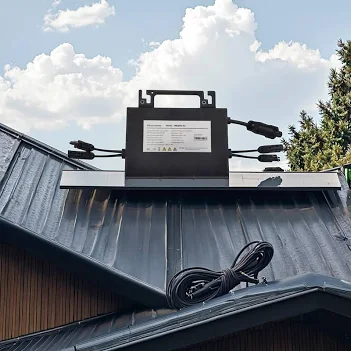
A hybrid microinverter solution provides an effective approach to overcoming these challenges. By performing power conversion and module-level optimization independently at each solar panel, hybrid microinverters improve energy harvesting, enhance system safety, and reduce long-term operational risks. Meanwhile, their built-in compatibility with battery energy storage systems (BESS) creates a flexible pathway for future energy upgrades and load management.
For commercial PV developers and procurement teams, this architecture can increase lifetime energy output, reduce maintenance complexity, and lower the cost per kilowatt-hour (kWh) over the system’s operational lifetime. The following sections explore the working principles, technical advantages, application scenarios, and total cost of ownership (TCO) analysis of hybrid microinverters in commercial solar projects.
Hybrid Microinverter vs. String Inverter: How LCOE Is Impacted
String inverters have traditionally been favored in commercial solar projects due to their lower upfront CAPEX, mature technology, and straightforward installation process. However, this advantage mainly applies to simple PV installations with uniform roof layouts, consistent orientations, and minimal shading. In reality, most commercial rooftops today involve complex conditions such as multiple orientations, partial shading, and uneven soiling.
The key difference lies in how each technology affects Levelized Cost of Energy (LCOE). While string inverters can reduce initial investment costs, their energy yield may be limited because all modules within a string operate based on the performance of the weakest module. A single shaded, dirty, or degraded panel can reduce the output of the entire string, causing cumulative energy losses over a 20+ year system lifetime.
A hybrid microinverter architecture changes this approach by providing module-level Maximum Power Point Tracking (MPPT) and independent DC-to-AC conversion. Each solar module operates at its optimal power point, allowing the system to capture more available energy and avoid the limitations of traditional string-based designs.
The “hybrid” capability also adds long-term value through seamless battery energy storage integration. As more markets adopt time-of-use electricity pricing and demand charge management, commercial solar systems need greater flexibility for self-consumption and peak shaving. Hybrid microinverters enable projects to start with grid-connected PV and add battery storage in the future without replacing the inverter system or redesigning major electrical components.
For commercial PV projects, this future-ready design improves energy yield, reduces lifetime operating costs, and creates additional financial value under changing electricity market conditions.
Key Specifications Checklist for Commercial Hybrid Microinverter Procurement
When evaluating hybrid microinverters for commercial PV projects, procurement teams should use a standardized specification checklist to ensure accurate comparison between different solutions.
1. System Sizing and Compatibility
- Module power compatibility: Verify the supported PV module range, such as 275–530 W per module, with up to 4 modules connected per microinverter unit.
- System capacity planning: Confirm the total number of modules, DC capacity (kW), target AC output, and grid export limitations.
- Project scalability: Consider phased installation requirements if the PV system will be expanded in multiple stages.
2. Electrical Performance and Grid Compliance
- AC output parameters: Check rated voltage, frequency range, operating voltage range, and compatibility with local grid standards.
- Power quality: Key indicators include THD below 5% and power factor above 0.99.
- Safety certifications: Ensure compliance with regional grid codes, anti-islanding requirements, and project-specific certification standards.
3. Energy Yield and Monitoring Capability
- Module-level monitoring: Hybrid microinverters should provide detailed performance tracking through wireless communication, enabling visibility into individual unit operation.
- Data management: Evaluate monitoring platform functions, data storage duration, user access control, and fault alert systems.
4. Environmental Protection and Reliability
- Operating temperature: Confirm performance under harsh conditions, typically from −40°C to +65°C.
- Protection rating: IP67 protection helps ensure reliable operation in outdoor commercial environments.
- Cooling design: Fanless natural convection reduces maintenance requirements and improves long-term reliability.
- Environmental adaptability: Check corrosion resistance requirements for coastal or industrial environments.
5. Model Selection Guide
- 1.6 kW hybrid microinverter: Suitable for four-module configurations using 275–530 W solar panels.
- 2.0–2.25 kW models: Recommended for higher-power modules or larger commercial PV applications.
Selecting the right hybrid microinverter specifications helps commercial solar projects achieve higher energy yield, lower O&M costs, and improved long-term LCOE performance.
Installation, Selection, and Maintenance: How Hybrid Microinverters Reduce TCO and LCOE
Selection Process for Finance-Ready Commercial PV Projects
A successful hybrid microinverter deployment requires both technical evaluation and financial modeling. The following steps help ensure accurate LCOE and TCO analysis:
Define financial objectives
Establish key targets, including LCOE, payback period, and electricity pricing factors such as time-of-use (TOU) rates, demand charges, and net metering policies.
Evaluate potential energy gains
Use shading analysis and realistic assumptions when estimating yield improvements. The expected 5–15% energy gain should only be applied to areas affected by shading, mismatch, or module-level performance losses.
Plan safety and compliance early
Confirm AC wiring design, grid protection settings, anti-islanding requirements, and monitoring access policies before installation.
Prepare for future energy storage
Determine whether battery storage will be installed immediately or added later, and ensure sufficient electrical capacity and control interfaces are available.
Verify system performance during commissioning
Complete acceptance testing through module-level monitoring to confirm individual unit output and create a reliable performance baseline.
TCO and Maintenance Advantages of Hybrid Microinverters
Lower O&M costs through modular design
With module-level architecture, a single microinverter failure only impacts the connected modules rather than the entire PV string. Remote fault identification and plug-and-play replacement significantly reduce service time and maintenance costs for distributed commercial rooftops.
Improved visibility and faster fault diagnosis
Module-level monitoring provides detailed performance data, helping identify issues such as uneven soiling, partial shading, and early module degradation that traditional string monitoring may overlook. Faster diagnosis reduces energy losses and improves system availability.
Enhanced safety and reduced operational risks
Hybrid microinverters minimize high-voltage DC exposure points and typically feature IP67 protection and fanless natural cooling designs. These features improve reliability, reduce failure risks, and can contribute to lower EHS and insurance-related costs over the system lifetime.
By combining optimized energy production, simplified maintenance, and improved safety, hybrid microinverters help commercial PV projects achieve lower total cost of ownership (TCO) and improved LCOE performance throughout a 20+ year operating period.
Conclusion: Reduce Commercial PV LCOE with Hybrid Microinverter Technology
For commercial PV projects facing challenges such as shading losses, module mismatch, rising O&M costs, DC safety compliance requirements, or future storage integration needs, a hybrid microinverter architecture provides a flexible and cost-effective solution.
By combining module-level MPPT with over 99.5% tracking accuracy, low-voltage DC design (maximum 60 V), IP67 protection, fanless natural cooling, and module-level Wi-Fi monitoring, hybrid microinverters improve lifetime energy production, simplify maintenance, and provide a storage-ready foundation for future system upgrades.
These advantages directly address the key factors influencing commercial solar LCOE reduction in 2026: maximizing energy yield, reducing operational costs, and improving long-term system flexibility.
Explore the Hootrum Hybrid Microinverter product range to find suitable models for your project and request a customized system recommendation.
To receive an accurate configuration proposal, provide the following project details:
- Site conditions: Rooftop or carport installation, shading conditions, soiling level, temperature range, and coastal/corrosive environment requirements.
- System size: Number of PV modules, total DC capacity, and planned installation phases.
- Electrical specifications: Module model and wattage, grid voltage/frequency, export limits, and switchgear requirements.
- Project targets: LCOE goal, payback period, expected yield improvement, uptime requirements, monitoring, and cybersecurity needs.
- Current challenges: Energy underperformance, string failures, frequent maintenance visits, safety audit issues, planned battery retrofit, or demand charge management requirements.
With the right system design, hybrid microinverters can help commercial solar projects achieve higher reliability, lower lifetime costs, and stronger long-term financial returns.
FAQ:
1. What is a hybrid microinverter?
A hybrid microinverter is a module-level power conversion device that performs DC-to-AC conversion and MPPT optimization for each PV module. Unlike traditional systems, it is designed with a storage-ready architecture, allowing battery integration either during initial installation or as a future upgrade without major system redesign.
2. Hybrid microinverter vs. string inverter vs. optimizer + string: Which solution is better?
The best choice depends on project conditions:
- String inverter: Offers the lowest upfront CAPEX and works well for simple PV arrays with uniform orientation and minimal shading.
- Optimizer + string inverter: Adds module-level MPPT to reduce mismatch losses but still relies on a centralized inverter and high-voltage DC architecture.
- Hybrid microinverter: Provides independent module-level conversion, eliminates high-voltage DC exposure, improves monitoring visibility, and supports future battery storage integration. It is especially suitable for complex commercial rooftops with shading, mismatch, and long-term flexibility requirements.
3. How does a hybrid microinverter reduce LCOE and improve solar ROI?
Hybrid microinverters improve Levelized Cost of Energy (LCOE) through two main factors:
- Higher energy production: Module-level MPPT can recover additional energy from shaded or mismatched modules, with potential yield improvements of 5–15% depending on site conditions.
- Lower operating costs: Modular design, remote fault diagnosis, and fanless cooling reduce maintenance time and annual O&M expenses.
The actual payback period depends on factors such as project complexity, electricity tariffs, labor costs, and system design.
4. Can hybrid microinverters be used for PV system retrofits?
Yes. A complete system redesign is usually unnecessary, but some electrical evaluations are required, including AC cable routing, grid interconnection review, and switchgear capacity verification.
A proper retrofit assessment should include shading analysis, single-line diagram review, and electrical infrastructure checks.
5. What information is required for hybrid microinverter selection and quotation?
To recommend the right configuration, suppliers typically need:
- PV module model, power rating, and total module quantity
- Grid voltage and frequency requirements
- Shading and mismatch conditions
- Export limitations and switchgear specifications
- Operating temperature range and environmental conditions
- Monitoring requirements
- Battery storage plans (current or future)
- Target LCOE, payback period, and performance expectations

